
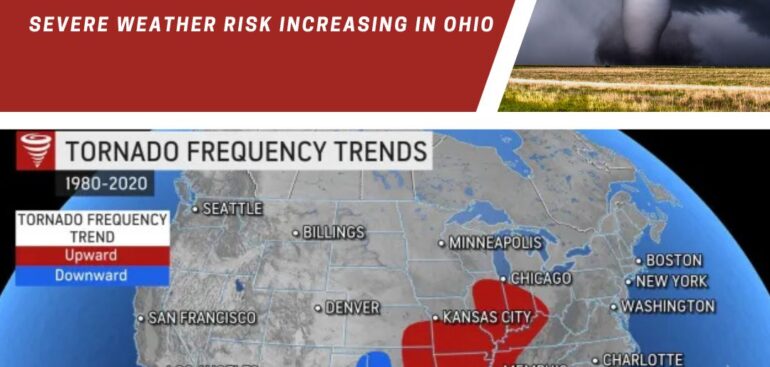
Severe weather patterns in the United States are shifting. What was once known as “Tornado Alley” in the Great Plains is gradually expanding eastward, bringing more frequent and more unpredictable tornado activity into the Midwest and Southeast.
For Ohio residents—especially those in Central Ohio and Fairfield County—this shift is no longer theoretical. It is becoming a measurable change in weather risk that affects homes, families, and insurance planning.
Tornado Activity in Ohio Is Reaching Record Levels
Recent data shows a clear upward trend in tornado activity across Ohio. In 2024, the state recorded 74 tornadoes, the highest total in recorded history.
This increase is part of a broader pattern of more active severe weather seasons across the Midwest. Areas including Fairfield County, Franklin County, Licking County, Pickaway County, and surrounding Central Ohio communities are increasingly included in tornado watches and warnings.
While not every storm produces tornadoes, the conditions that create them—warm moist air, atmospheric instability, and shifting jet stream patterns—are appearing more frequently in the region.
The Shift East From Traditional Tornado Alley
 Historically, Tornado Alley referred to a region stretching through Texas, Oklahoma, Kansas, and surrounding Plains states. However, over the past couple of decades, research and storm tracking have shown a gradual eastward shift in severe weather activity.
As a result, states like Ohio are now experiencing:
- More frequent severe thunderstorms
- A higher number of tornado warnings per season
- Wider geographic spread of tornado risk across urban and suburban areas
This means communities that were once considered lower-risk are now increasingly part of active storm tracks.
Fairfield County and Central Ohio Are Increasingly Affected
Fairfield County and surrounding Central Ohio communities are now regularly included in severe weather systems during peak storm season. Cities and towns that may be impacted include Lancaster, Pickerington, Canal Winchester, Reynoldsburg, Newark, Circleville, and broader areas of the Columbus metro region.
Southeast Ohio communities such as Athens and nearby counties also face elevated risk during strong storm systems moving through the state.
Severe weather in this region is no longer isolated or rare—it is part of a broader pattern affecting much of Ohio.
Historical Context: The 1974 Xenia Tornado
Ohio’s history with tornadoes includes one of the most well-known severe weather events in U.S. history: the 1974 Xenia tornado, which occurred during the Super Outbreak of April 3–4, 1974.
The tornado devastated much of the city of Xenia and shocked residents who had little prior experience with storms of that magnitude. Entire neighborhoods were damaged or destroyed, and the event became a defining moment in how Ohio communities understood tornado risk.
Meteorologists have often pointed to events like Xenia in 1974 as a turning point in public awareness of severe weather. At the time, such destruction was seen as extraordinary. Today, however, Ohio experiences tornado activity more frequently across a much wider geographic area.
How to Prepare Before Severe Weather Hits
Preparation is one of the most effective ways to reduce risk during tornado season. Residents should begin by identifying where they will go in the event of a tornado warning, such as a basement or an interior room on the lowest level of the home without windows.
It is also important to ensure there are multiple ways to receive emergency alerts. Fairfield County residents, for example, can sign up for local emergency notifications through fairfieldema.com/alerts to receive warnings via text and phone.
Many homeowners also prepare emergency kits ahead of storm season. These kits typically include water, flashlights, batteries, medications, phone chargers, and important documents in case evacuation or extended power outages occur.
Finally, reviewing homeowners insurance coverage before severe weather season begins can help ensure families understand what protection they have in place if damage occurs.
What to Do During a Tornado Warning
When a tornado warning is issued, immediate action is critical. Residents should move quickly to their designated safe area and avoid windows, exterior walls, and doors.
If possible, individuals should protect themselves with mattresses, helmets, or heavy blankets to reduce injury from flying debris. Mobile homes and vehicles are not safe during tornado conditions, and anyone in those situations should seek a sturdy building immediately.
It is important not to wait for visual confirmation of a tornado, as these storms can form and move rapidly with little warning.
What to Do After Severe Weather Passes
After a storm has passed, hazards may still be present even if conditions appear calm. Downed power lines, flooding, and structural damage can create ongoing risks, so caution is essential.
Residents should avoid entering damaged buildings until they are declared safe by authorities. If property damage has occurred, taking photographs as soon as it is safe to do so can help support insurance claims and speed up the recovery process.
Contacting your insurance provider promptly after a storm ensures that claims can be initiated quickly and that recovery steps can begin as soon as possible.
When Tornadoes Are Most Likely in Ohio
While tornadoes can occur at any time of year, they are most common in Ohio during the late spring and early summer months. The peak season typically runs from April through July, when warm, moist air from the Gulf of Mexico interacts with cooler northern air masses and strong jet stream activity.
This combination creates the unstable atmospheric conditions that are most favorable for severe thunderstorms and tornado formation. Although Ohio can experience tornadoes outside this window, late spring remains the most active period for severe weather in the region.
Final Thoughts
From the historic impact of the 1974 Xenia tornado to recent record-breaking tornado counts across Ohio, one thing is clear: severe weather risk in the state is changing. Central Ohio is no longer outside the influence of Tornado Alley patterns. Instead, it is increasingly part of a broader and more active severe weather region. For homeowners, awareness, preparation, and proper insurance coverage are no longer optional considerations—they are essential parts of living in Ohio today.